
How to Choose the Electric Cargo Pickup Truck
With the growing demand for urban delivery, agricultural transport, industrial park logistics, and commercial freight, electric cargo pickup trucks have emerged as a compelling option for businesses seeking flexible, cost effective, and convenient transport solutions for daily operations. Compared to traditional fuel powered trucks, electric cargo vehicles, characterized by their electric powertrains, rechargeable battery systems, and suitability for low speed transport, are well suited for short haul freight tasks, provided they comply with local regulations and operational requirements.
For importers, wholesalers, distributors, and procurement professionals, selecting the right electric cargo pickup truck involves more than just comparing motor power and price. It requires a comprehensive evaluation of factors such as payload capacity, range, battery configuration, braking systems, driving comfort, intended use cases, and the level of product support provided by the supplier.
Using the AMOTO A41 electric cargo pickup truck as a case study, this article outlines key selection criteria, essential product specifications, typical use cases, and important procurement considerations to helping buyers efficiently assess whether a particular vehicle aligns with their specific operational needs.
1.What Is an Electric Cargo Pickup Truck
An electric cargo pickup truck is a transport vehicle equipped with an electric powertrain and a dedicated cargo carrying area. These vehicles are primarily used for short haul logistics, farm operations, internal transport within industrial facilities, commercial deliveries, and other light duty or specialized freight tasks.
Unlike standard electric passenger vehicles, electric cargo pickup trucks place a greater emphasis on cargo capacity, operational efficiency, low speed maneuverability, and overall utility. For businesses that require frequent transport of goods along fixed routes or within confined areas, these vehicles serve as an effective alternative or supplement to traditional, fuel powered transport vehicles.
When considering a purchase, it is recommended to focus on the following six key aspects:
| Payload Capacity | Confirm whether the maximum allowable load meets the requirements for transporting the cargo. |
| Battery Capacity | Confirm whether the battery capacity can support the planned daily operating mileage. |
| Driving Range | Verify whether the range on a single charge covers the actual operational route. |
| Motor Power | Confirm whether the motor output is sufficient for loaded operation and inclines. |
| Safety Features | Confirm whether the braking system, tires, and reversing assistance features meet operational requirements |
| Supplier Support | Confirm whether the supplier can provide clear technical specifications, certification documents, and support for export procurement. |
2.Meet the AMOTO A41 Electric Cargo Pickup Truck
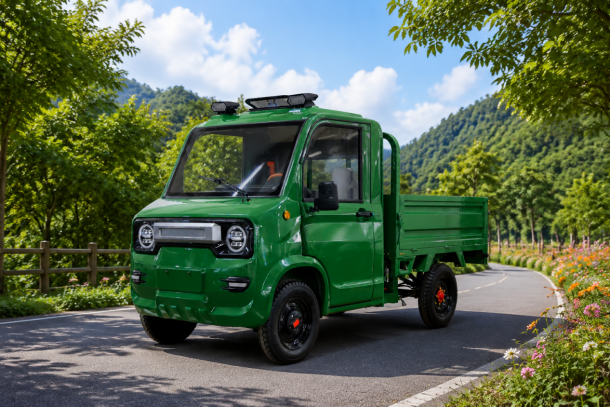
The A41 is a 4 wheeled electric cargo pickup truck from the AMOTO product lineup. It features a 72V electric powertrain, a 3.0kW motor, and a 106Ah lithium battery, and comes equipped with a separate cargo bed, front and rear disc brakes, as well as various driver assistance and comfort oriented features.
Its design focuses on balancing cargo hauling capacity, everyday driving performance, and practicality, making it well suited for users who need to transport goods within settings such as farms, industrial parks, warehouse facilities, and other appropriate locations.
For buyers who are in search of an electric cargo pickup truck, the A41 serves as a potential option to consider. When making an actual purchase, however, its suitability should be verified based on local regulations, road conditions, cargo weight, and the vehicle's final configuration.
AMOTO A41 Key Specifications
| Size | Dimension | 2995*1369*1709mm |
| Wheelbase | 1965mm | |
| Track Width front | 1118mm | |
| Track Width rear | 1159mm | |
| Wheelbase | 1965mm | |
| Cargo Bed | 1374*1267*674mm | |
| Motor | Motor Voltage | 72V |
| Motor Power | 3000W | |
| Grade Ability | 18° slope | |
| Maximum Torque | 8.0 Nm at 3600 Min-1(Variant 00) | |
| 9.3 Nm at 3000 min-1(Variant 01) | ||
| Controller | Controller Type | ST-80 |
| Battery (Lithium) |
Battery Voltage | 72V |
| Battery Capacity | 106AH | |
| Range per Charge | 115-127KM | |
| Charging Time | 6-8H | |
| Speed | Maximum Speed | 25/40 KM/H |
| Tire Type | Front | 4.50-12 |
| Rear | 4.50-12 | |
| Brake Type | Front wheel | disc brake |
| Rear wheel | disc brake | |
| Weight | Curb weight | 397KG |
| Max Permissible Load | 829KG | |
| Standard Additional equipment |
Bluetooth | yes |
| Heater | yes | |
| Sunroof Fan | yes | |
| Rearview Camera | yes | |
| Steering Wheel | yes |
3.How to Choose the Right Payload Capacity
-
The total weight of the cargo falls within the allowable load limit.
-
The length, width, and height of the cargo are suitable for the available platform of the cargo pickup truck.
-
The cargo can be distributed evenly and secured reliably once loaded.
-
The vehicle remains safe to operate in terms of braking, cornering, and navigating inclines when fully loaded.
4.Evaluate Battery Capacity and Driving Range
- Record the estimated daily mileage for each vehicle.
- Calculate the proportions of travel under fully loaded, empty, and uphill conditions.
- Determine whether vehicles can be charged during breaks in their daily operation.
- Assess the impact of local climate and temperature on battery performance.
- Verify the test conditions and real-world range for the specified vehicle configuration with the supplier.
5.Additional Safety and Practical Features
- Front and rear disc brakes: Provide the foundation for the vehicle's braking system. Actual braking performance also depends on factors such as vehicle load, tires, road conditions, and maintenance status.
- Reversing camera: Assists the driver in monitoring the area behind the vehicle, helping to reduce blind spots while reversing.
- Heating system: Provides added comfort when driving in suitable climate conditions.
- Sunroof fan: Improves air circulation inside the vehicle.
- Bluetooth functionality: Offers connectivity and entertainment features.
- Electric hydraulic dump system: Depending on specific needs, the vehicle can be equipped with an electric hydraulic lifting system to help users unload cargo with ease.
6.Where Can You Use the AMOTO A41 Electric Cargo Pickup Truck
-
Agriculture and Farm Transport
-
Warehouse and Industrial Park Logistics
-
Commercial and Local Delivery
7.What Should Buyers Check Before Ordering
- Confirm the final technical specifications. Request a specification sheet from the supplier that corresponds exactly to the version being sold. Pay close attention to the motor, battery, range, speed, load capacity, braking system, and vehicle dimensions.
- Verify certifications and registration documentation. Even if a supplier claims that a model has obtained specific certifications, buyers should independently verify the validity of these certificates,as well as compliance with applicable regulations and required documentation based on the specific model, vehicle category, target market, and configuration. For the European market, for instance, confirm whether EEC certification is required.
- Clarify standard and optional features. For the A41 model, items such as roof top lights, electric hydraulic dump, range extenders, and air conditioning are available as optional. Buyers should determine whether these extras are necessary and ensure they meet local regulatory requirements.
- Evaluate charging and maintenance requirements. Confirm the charger specifications, power supply requirements, battery maintenance procedures, after-sales support, and the availability of wear-and-tear parts. Additionally, plan for designated vehicle parking and charging areas in advance.
- Calculate the total cost of ownership. Beyond the initial purchase price, consider factors such as charging costs, maintenance expenses, transportation, potential downtime, and the expected service life of the vehicle. Only by incorporating real-world operational data can you accurately compare the long-term economic viability of different models.
8.FAQ
Q1: What is the maximum load capacity of the AMOTO A41?
According to the A41 EEC certificate, this model has a maximum permissible load of 829 kg and a curb weight of 397 kg. Purchasers should refer to the actual specifications and adhere to the vehicle's prescribed load limits.
Q2: What battery does the AMOTO A41 use?
The standard configuration required for official certification is 72V 106Ah lithium battery. Before making a purchase, it is recommended to verify the battery model, usable capacity, charger specifications, and the final delivered configuration.
Q3: What is the driving range of the AMOTO A41 electric cargo pickup truck?
According to the EEC certificate issued by the testing agency, this model has a theoretical range of 115-127 km. Actual range may vary based on factors such as load, temperature, road gradient, driving style, and battery condition, please refer to actual performance for the definitive figures.
Q4: How long does it take to charge the AMOTO A41?
The theoretical charging time is 6-8 hours. The actual charging time depends on the battery status, charger specifications, power supply conditions, and ambient temperature.
Q5: Is the AMOTO A41 suitable for farm and warehouse transport?
The A41 is a potential vehicle choice for short-distance transport within farms, warehouses, and industrial parks. Its suitability for a specific task should be evaluated based on factors such as cargo weight, road conditions, gradients, available clearance, and local regulations.
Q6: How can I confirm whether the AMOTO A41 meets my market requirements?
It is recommended to first obtain from the supplier the technical specifications, relevant certification documents, and registration materials required for the target market for the final commercial version of the product. Verify that key information such as motor specifications, battery details, load capacity, and vehicle speed is consistent across these documents. For the European market, it is particularly important to confirm the vehicle classification, EEC related documentation, and all applicable certification requirements.
Buying the right electric cargo pickup truck requires a comprehensive evaluation of factors such as load capacity, battery capacity, driving range, motor performance, braking systems, specific operational environments, and regulatory requirements in your target market, rather than relying solely on a single parameter or the purchase price.
The AMOTO A41 electric cargo pickup truck features a 3000W motor and a 72V106Ah lithium battery. It offers a versatile electric cargo platform, ample cargo space, front and rear disc brakes, and a range of practical features. It is a model worth considering for applications in settings such as farms, warehouses, industrial parks, and localized delivery operations.
If you are looking for an electric cargo pickup truck for commercial distribution or business transport projects, please visit https://www.amoto.group to learn more about the A41, and contact the AMOTO team to receive the latest details, pricing, and additional information.
How to Choose an Electric Vehicle Manufacturer for Your Business