
The Ultimate EV Sourcing Guide: Calculating Range, Speed, Climbing Grade, and Battery Lifespan for B2B Importers
The Ultimate EV Sourcing Guide: Calculating Range, Speed, Climbing Grade, and Battery Lifespan for B2B Importers
Introduction
For international distributors, fleet procurement managers, and e-commerce entrepreneurs, investing in electric vehicles (EVs)—whether they are smart urban e-scooters, heavy cargo tricycles, or light electric pickups—requires a calculated evaluation of performance metrics.
End-users and commercial clients don’t just buy a vehicle; they buy solutions to specific daily needs: How far can it go on a single charge? Can it climb the steep hills in our logistics zone? How long will the battery last before needing an expensive replacement? To help B2B buyers make data-driven decisions and provide accurate technical consultation to their local markets, this comprehensive engineering guide breaks down the essential formulas, physics, and battery chemistry comparison behind EV performance.
1.The Core Powerhouse: Comprehensive Comparison of Battery Chemistries
The battery pack is the single most significant cost component in an electric vehicle. Choosing between Graphene Lead-Acid and Lithium-Ion technology dictates not only the upfront purchasing cost but also the long-term operational viability of the vehicle fleet.
|
Performance Metric
|
Graphene Lead-Acid Batteries
|
Lithium-Ion Batteries (NCM / LiFePO4)
|
|
Energy Density
|
Low (35 - 50Wh/kg)
|
High (150 - 260Wh/kg)
|
|
Cycle Life (100% DoD)
|
400 - 600 Cycles
|
1000 - 3000+ Cycles
|
|
Weight (For 72V 20Ah)
|
Heavy (Approx. 35 - 42 kg)
|
Light (Approx. 7 - 10 kg)
|
|
Initial Capital Cost
|
Low / Budget-friendly
|
Higher upfront investment
|
|
Charging Efficiency
|
Moderate (75% - 85%)
|
Excellent (90% - 95%)
|
|
BMS Integration
|
Basic analog or none
|
Advanced Smart BMS (Overcurrent, Thermal, Balance)
|
Deep-Dive: Graphene Lead-Acid Batteries (Pros & Cons)
-
The Advantages: Lead-acid batteries enhanced with graphene compounds represent the pinnacle of traditional chemistry. Their primary edge is extreme cost-effectiveness. For emerging markets in Latin America, Africa, and parts of Asia, initial capital expenditure (CAPEX) is often the defining factor for end-consumers. Furthermore, they are highly stable, completely non-flammable, easy to recycle globally, and perform reliably in basic low-speed short-distance transport.
-
The Disadvantages: They are incredibly heavy. High weight directly reduces the overall payload efficiency of cargo trikes. They suffer from the Peukert Effect (meaning if you draw high current for fast speeds or heavy loads, the usable capacity drops drastically). With a lifespan limited to 400 to 600 cycles, fleet operators must replace the entire pack every 12 to 18 months under heavy commercial use.
Deep-Dive: Lithium-Ion Batteries (Pros & Cons)
-
The Advantages: Lithium-ion cells (typically Ternary NCM or Lithium Iron Phosphate LiFePO4) offer an exceptional energy-to-weight ratio. A lithium pack is roughly 75% lighter than its lead-acid equivalent, instantly translating into a higher vehicle cargo payload and reduced mechanical stress on the frame and brakes.
-
With a cycle life ranging from 800 cycles (NCM) to over 2,000–3,000 cycles (LiFePO4), a single lithium pack can last 3 to 5+ years. They also support fast-charging capabilities and feature an integrated BMS (Battery Management System) that monitors voltage, temperature, and cell balancing to prevent thermal runaway.
-
The Disadvantages: The primary hurdle is the initial purchase price, which can be 2 to 3 times higher than lead-acid. Additionally, lithium batteries require strict compliance with international shipping regulations (UN38.3 certification for maritime transport) and demand robust waterproof, shockproof casing designs to ensure absolute field safety.
2.The Science of Range: How Far Can Your Clients Ride?
One of the most common pitfalls in international EV procurement is relying solely on Ampere-hours (Ah) to guess range. To discover the actual total energy potential of any vehicle, you must calculate Watt-hours (Wh) or Kilowatt-hours (kWh).
The Total Energy Formula
Energy (Wh) = Voltage (V)*Capacity (Ah)
Let's evaluate two typical commercial configurations:
-
Standard Commuter Setup: A 60V 20Ah battery pack yields:
-
60V×20 Ah= 1200 Wh= 1.2 kWh
-
Heavy-Duty Cargo Setup: A premium 72V 40Ah lithium pack yields:
-
72V*×40 Ah = 2880Wh = 2.88kWh
Estimating Real-World Energy Consumption
Under standard urban riding conditions, different vehicle classes consume energy at varying rates per kilometer based on aerodynamics, weight, and rolling resistance:
-
Light-Weight E-Scooters (e.g., Fleet Sharing Models): ≈20Wh/km to 25 Wh/km
-
Mid-tier Electric Motorcycles: ≈ 35 Wh/km to 45 Wh/km
-
Heavy Cargo Trikes / Delivery Pickups: ≈60Wh/km to 85 Wh/km (varies dynamically by payload)
Using the True Range Estimation Formula:

If an e-scooter with a 1200Wh pack consumes 20Wh/km, its realistic range is:
1200Wh÷20 Wh/km = 60km
If a heavy delivery trike equipped with a 2880Wh lithium battery consumes 65 Wh/km while transporting cargo, its range is:
2880Wh÷65 Wh/km ≈44.3km
B2B Insight: Inform your clients that real-world range fluctuates depending on driver driving habits, cargo load, headwinds, and extreme ambient temperatures.
3.Motor Power Dynamics vs. Maximum Velocity
Motor wattage selection directly controls the top velocity and torque of an electric vehicle. When configuring your imported fleet inventory, balancing top speed with regional road regulations is critical for customs clearance and licensing compliance.
-
350W – 500W Brushless DC (BLDC) Hub Motors: Engineered primarily for urban micro-mobility and app-based scooter sharing networks. They provide a legally compliant top speed of 25 km/h to 35 km/h, adhering closely to strict European Union and North American municipal restrictions.
-
1000W – 1500W Motors: The industry baseline for mid-tier commuter electric motorcycles and lighter delivery tricycles, capable of reaching stable cruising speeds of 45 km/h to 50 km/h.
-
2000W – 3000W+ High-Torque Central/Hub Motors: Found in heavy-duty utility cargo trikes and light electric pickup trucks. These robust powertrains can easily push heavy vehicles to highway or regional speeds of 60 km/h to 80+ km/h, ensuring fast regional transit even when loaded to maximum payload capacity.
4.Decoding Climbing Gradeability: Slopes vs. Angles
B2B buyers frequently confuse climbing angles (degrees, °) with slope percentages (%) displayed on specification sheets. International transport standards generally utilize the slope percentage metric.
The conversion formula is defined as:
Gradeability (%) = tan×100%
Where represents the actual angle of the incline. Let’s look at real-world scenarios:
-
An 8.5° Angle≈15% Slope: This represents standard steep multi-story underground parking garage ramps or standard highway overpasses.
-
A 15° Angle ≈27% Slope: This represents highly demanding, steep historic urban streets (such as those found in San Francisco, or mountainous residential sectors in Latin America).
-
A 20° Angle ≈36.4% Slope: This is an extreme environment. Only specialized cargo vehicles equipped with high-torque gear-reduction axles, 3000W+ motors, and high-current Field-Oriented Control (FOC) vector controllers can scale these inclines without stalling or overheating the power electronics.
5.Charging Time,Efficiency,and Grid Electricity Consumption
For commercial fleet operators, understanding charging dynamics allows dispatchers to map out delivery shifts, minimize vehicle downtime, and calculate precise overhead expenses.
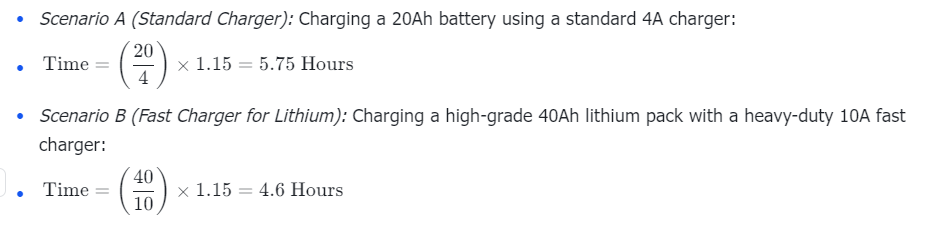
1.The Charging Duration Formula
Most standard smart EV chargers do not charge linearly. Instead, they follow a highly specific CC/CV (Constant Current / Constant Voltage) profile to protect cell longevity.
During the Constant Current (CC) stage, the charger pumps maximum current into the battery, bringing it rapidly to about 80% capacity. Once the battery reaches its upper voltage limit, it transitions to the Constant Voltage (CV) stage. During this phase, the voltage stays constant while the current gradually tapers down to a trickle. This prevents the cells from overheating but elongates the final 20% of charging time.
To mathematically account for this slower CV phase, engineers implement a safety coefficient of 1.15:

2.Wall-to-Wheel Grid Power Consumption
How much does it cost to "fill the tank"? To calculate how much electricity is actually drawn from the local power grid, we must account for the heat loss and efficiency limitations of the charger (averaging 85% for lead-acid and up to 92% for premium lithium systems):
This proves that an end-user or business owner consumes approximately only 1.7 units of electricity from their utility grid to fully charge the vehicle, achieving over 60–70 kilometers of commercial transport. Compared to traditional internal combustion engines (ICE), the operational savings are massive.
Conclusion
Navigating the technical landscape of electric vehicles enables international importers to source inventory strategically, match localized geographic topography, and build high-trust marketing narratives for local buyers.
By matching precision battery capacities, motor outputs, and charging behaviors to the exact operational needs of your target market, your distribution business can maximize both product reliability and long-term profitability in the rapidly evolving global EV marketplace.
Amoto Global Market Insights: Why the World Is Choosing Electric Mobility
Best Electric Cargo Vehicles for Small Business Delivery